
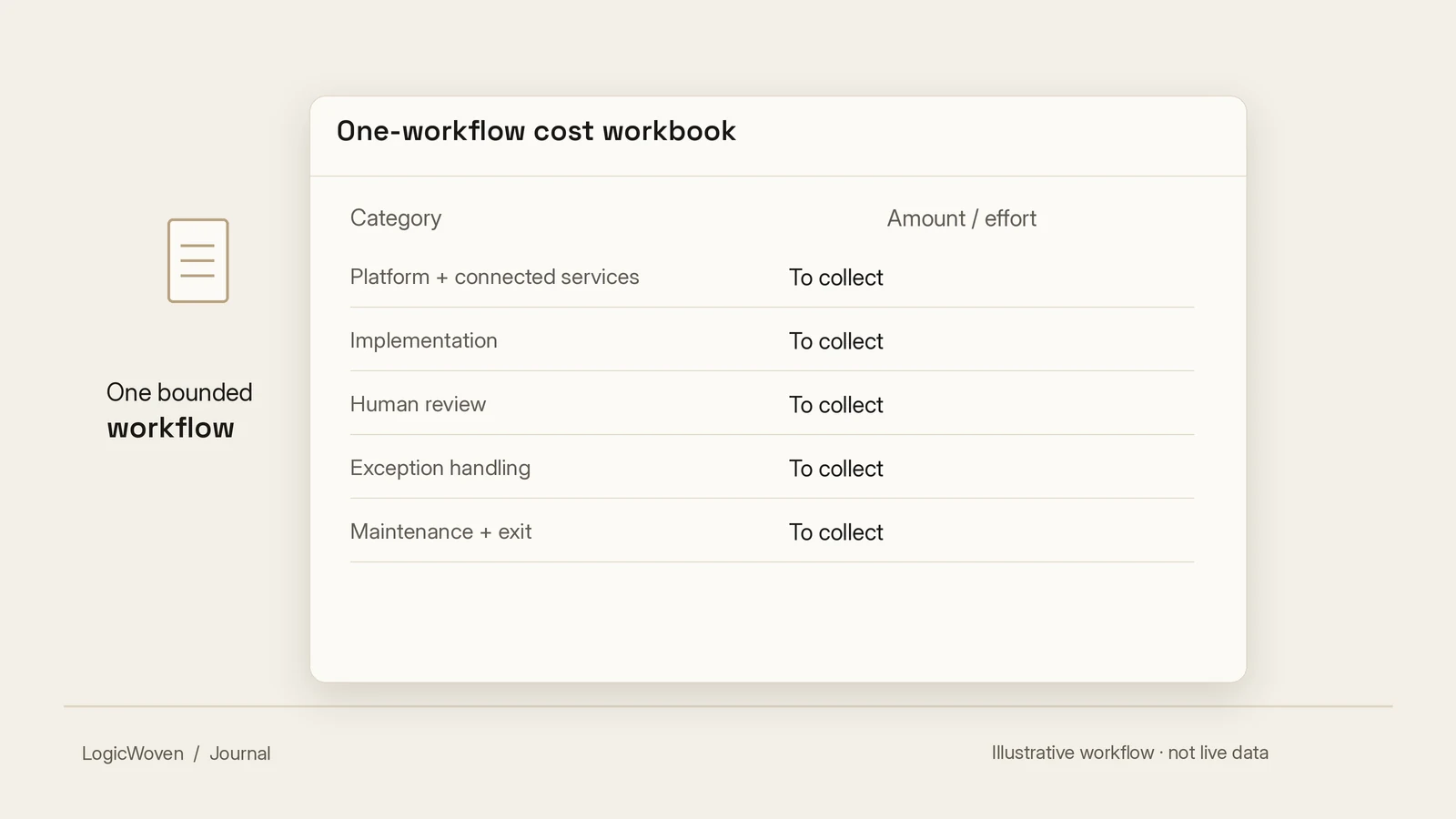
An automation budget should include the platform, connected services, implementation, human review, exception handling, maintenance, and eventual handover or exit. A subscription quote covers only the items named in that quote. Before choosing n8n or another platform, write down the workflow you intend to operate and price the responsibilities required to keep it useful.
For a small-business owner, the first output is a complete inventory for one workflow, not a ranking of platforms or suppliers. Use n8n as a documented billing example while keeping the cost categories applicable to other stacks.
Begin with the unit the vendor charges for
n8n's pricing page describes pricing based on monthly workflow executions, regardless of complexity.[4] It distinguishes n8n-hosted and self-hosted offerings and lists a standard self-hosted Community Edition.[4] These are documented product options, not a finding that one deployment model is always cheaper.
An execution is the vendor's stated billing unit on that page. It is not automatically equivalent to one customer, one successful outcome, or one staff task. Ask the supplier to map the proposed workflow to the current plan's allowances, treatment of tests and retries, and any applicable limits. Confirm those details against the actual proposal and terms rather than inferring them from a headline price.
This guide intentionally does not reproduce a subscription price. The worksheet is designed to survive a price change, while the customer's current quote remains the authority for the amount, currency, billing frequency, and commitment.
If a connected HubSpot workflow consumes a shared account pool, shared-credit contention is a separate input to the usage assumptions.
Inspect HubSpot renewal exposure where the budget depends on extra credits rather than treating every charge as a one-month expense.
Bound the one workflow being costed
Write an operating specification: the event that starts the workflow, the systems it reads, the records it may change, any approval step, and the evidence of correct completion. Identify the manual alternative if it is unavailable.
Keep optional enrichment outside the initial inventory unless it is part of the approved scope. A request to add another input, a new report format or external sending should reopen the cost assumptions rather than silently joining the original build.
Choose one planning period and name its start and end before filling recurring rows. This article builds a category-complete inventory for that workflow. Comparing different supplier inclusions belongs in a separate proposal review.
Prepare the CRM integration quotation inputs
For a CRM integration, give the supplier a scope-driver checklist before asking for an estimate. Use it to expose unknown work, not to assume every CRM supports the same connection or that a standard package includes it:
- Systems and access: Which website, CRM and connected tools are involved? Confirm the edition, available API or connector access, and who can authorize a test connection.
- Fields and pipelines: Which fields, stages and ownership rules need mapping? Identify the source of truth and the person who approves each mapping.
- Existing records: Is this a new-data connection or a cleanup and migration too? Describe the record volume, known duplicates and missing fields; assign responsibility for preparing and checking the data.
- Permissions and decisions: Who may read, create or change records? Separate routing rules from optional AI assistance, and identify actions that need human approval.
- Exceptions and acceptance: Specify missing-data, duplicate-event, retry and failed-delivery cases. Agree authorized test records, expected results and the reviewer. For website inquiries, test the form-to-CRM handoff rather than accepting a confirmation screen as the finish line.
- Transfer and support: Identify training, documentation, access transfer and the manual fallback. Ask which maintenance and support duties are included and which need a separate scope.
Capture each unresolved item as system → required change → known constraint → client/supplier responsibility → evidence still needed. For example, this hypothetical preparation record contains no price or tested result: existing CRM → map the service-request field → API access unconfirmed → client account owner confirms access; supplier checks the mapping → edition and permission evidence pending. Do not send passwords or private customer records with the initial request.
Keep these inputs alongside the full-cost worksheet below. They define what needs quoting; they do not replace the internal-reporting example or the later comparison of supplier proposals.
The LogicWoven full-cost worksheet
Use the table as a blank estimating structure. Each amount should be marked as a current quote, a measured internal cost, an estimate, or unknown. Do not turn unknown into zero.
| Cost category | Questions to answer | Evidence and owner |
|---|---|---|
| Discovery and design | Which workflow, fields, approvals, and exceptions are included? | Scoped proposal; project owner |
| Build and testing | What integration work, test data, and acceptance checks are funded? | Delivery estimate; implementation owner |
| Platform subscription | Which plan, meter, allowance, and commitment apply? | Dated quote; billing owner |
| Connected applications | Are extra CRM, email, or other software seats required? | Account review; application owners |
| Model or external API use | Which calls are made and who pays for them? | Usage trace and provider terms |
| Hosting and operations | Who provides runtime, storage, monitoring, and recovery? | Hosting scope; technical owner |
| Human review | Who checks proposed actions and corrections? | Observed pilot effort; operations lead |
| Exceptions and incidents | Who handles failures and manual work? | Runbook and support scope |
| Maintenance and change | Who updates mappings, credentials, and dependencies? | Agreed maintenance arrangement |
| Training and handover | Can staff operate the workflow without the builder? | Training and documentation scope |
| Exit | What must be exported, rebuilt, or transferred? | Exit plan; business owner |
Keep one-time work separate from recurring obligations. Keep cash charges separate from internal staff capacity. Then choose a comparison period and apply the same period to every option. The point is not to create a large spreadsheet; it is to prevent a cheap-looking row from concealing an expensive responsibility elsewhere.
Filled inventory: one internal reporting workflow
Consider a hypothetical workflow that reads an approved job-status export, drafts a weekly internal report and leaves it for review. It does not contact customers or update source records. The entries below are estimating decisions, not prices, observed measurements or a supplier comparison.
| Inventory item | What this workflow needs | Cost basis and unresolved evidence |
|---|---|---|
| Design and build | Map approved export fields to the report; define missing-input behavior | Obtain a scoped implementation quote, including acceptance tests |
| n8n platform | Run the scheduled workflow and permitted retests | Confirm the selected plan's execution treatment; amount unknown until quoted |
| Connected services | Read the export and create a private report file | Check existing permissions and whether additional seats or storage are charged |
| Model use | Draft only the narrative that needs language assistance | Estimate from an authorized trace; do not treat the platform subscription as model credit |
| Runtime and recovery | Keep the selected hosting arrangement available and recoverable | Record what the actual hosting scope includes; leave uncovered duties unresolved |
| Review | Check totals, missing records and the draft's interpretation | Observe review effort during a pilot; record as staff capacity, not a cash invoice |
| Exceptions | Handle an absent export or unsupported field change | Name the operator and estimate from test cases rather than assuming zero |
| Maintenance and exit | Update mappings; retain usable configuration and source references | Quote or assign this work separately, including transfer rights |
The output is one inventory with an evidence status for every obligation. A blank amount remains unknown. An existing subscription can mean no additional cash charge for a row, but record the allowance and permission that support that conclusion. Do not enter zero simply because another department pays the invoice.
Separate costs without double-counting them
Use three columns in the working budget: one-time cash, recurring cash over a stated planning period, and internal effort. If a support quote includes monitoring, do not add the same supplier task again under maintenance. If staff still review exceptions, keep that internal work visible even when the supplier sells monitoring.
A contingency is an assumption, not an observed expense. State which uncertainties it covers and what would trigger a revised estimate. A new intake source, a larger report audience or permission to write back to the source system changes this inventory and should reopen the scope.
n8n lists governance and support differences across offerings.[4] Confirm required capabilities for the selected plan. Hosting responsibility and the later comparison of competing proposals are separate decisions; this worksheet provides their cost inputs without choosing a winner.
Make the pilot settle the uncertain rows
A bounded pilot can collect handling time, review time, exception types, and actual usage traces. Include representative awkward cases, not just the cleanest input. Retain enough evidence to explain why a run required correction without collecting unnecessary customer data.
Use those observations to revise estimates. A task that seems fast while watched by the builder may need more support when ordinary staff operate it. A workflow that creates many drafts but few usable outputs should not be evaluated on draft count alone.
Do not translate released minutes directly into payroll savings. Time can become additional capacity, better follow-through, or less overtime; a cash-saving claim needs evidence of an expense actually reduced or avoided. Keep the distinction visible in the approval memo.
If the workflow uses Agents, compare Zapier test and production accounting before using a quiet test counter as cost evidence.
Close the inventory before seeking a comparison
A second manager should be able to identify every charge, internal responsibility, assumption and unresolved amount from the sheet. Give each unknown an evidence request and owner. If a critical operating duty is unowned, mark the workflow as not yet budgeted rather than presenting an artificially low total.
The inventory may show that an existing rule or a simpler manual report is enough. It should make that option visible, not presume a new platform is necessary.
A useful quote starts with the workflow, access and responsibilities—not a standard package. LogicWoven can help define a CRM integration scope and delivers remotely for businesses in the United States, the United Arab Emirates and worldwide.[8] Pricing is bespoke: agree hourly work or a one-time project fee for the defined scope, with operating costs and support made explicit. See how scope and ongoing costs are agreed.[9] Discuss a one-workflow automation budget, bringing the process boundary and the costs you can already substantiate.
Once this inventory is usable, compare automation proposals on the same assumptions to separate supplier inclusions from client-owned work.