

LogicWoven Journal
Faster replies are not better follow-up: measure what happens after an inquiry
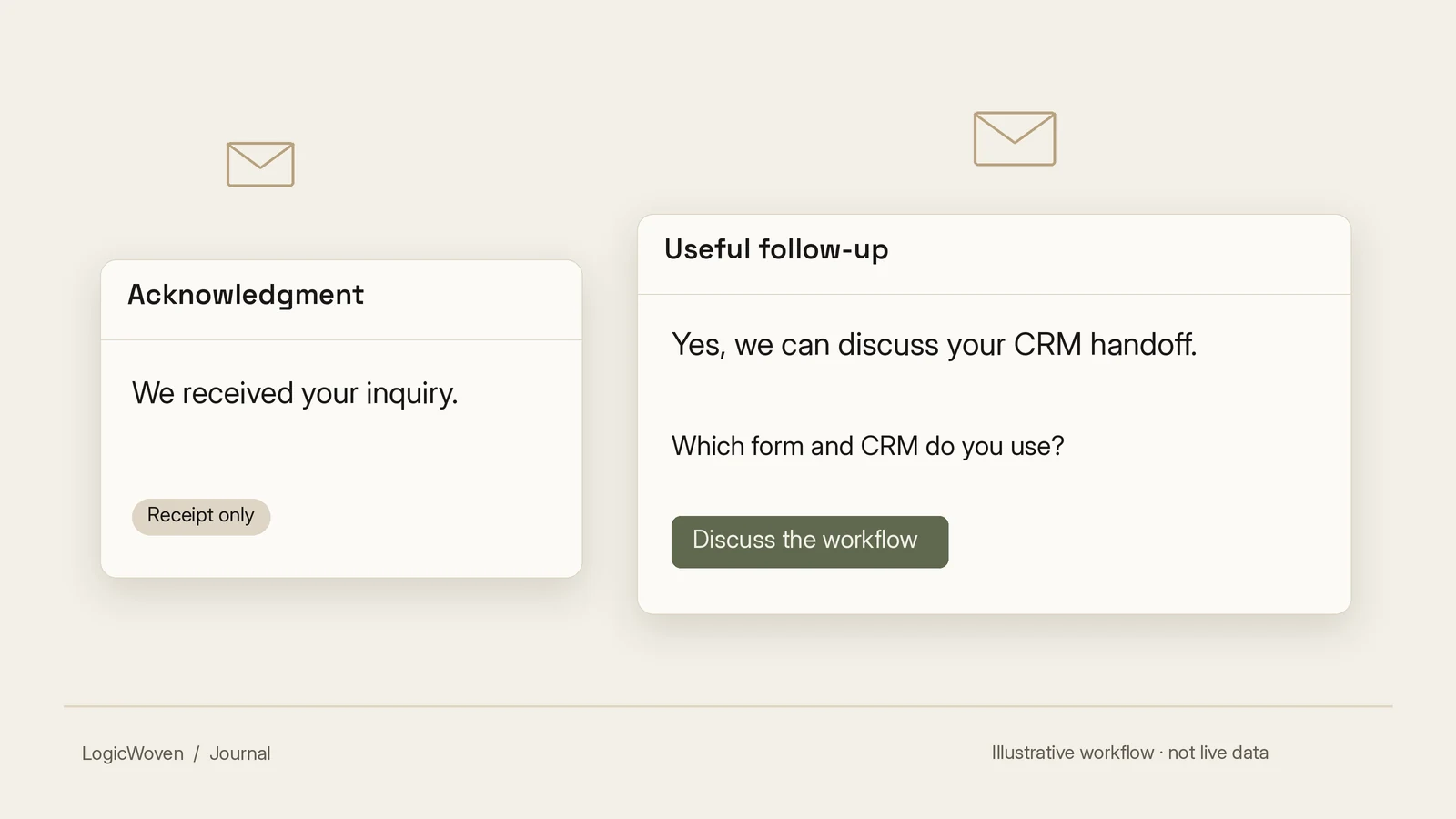
Measure follow-up by what happens after receipt: whether an inquiry reaches an owner, gets a useful response, and moves toward an appropriate next step. Track acknowledgment speed separately. An instant “we received your message” can be useful, but it does not establish that anyone understood the request or helped the prospect decide what to do.
For a small service business, a useful starting report is an inquiry event log plus a short response-quality review. You do not need a complicated scoring model. You need consistent definitions, visible unfinished work, and a way to distinguish a genuine improvement from a faster automated message.
Define the events before building the dashboard
Use the following event map as a proposed worksheet. These are working definitions for your team to adapt, not universal CRM stages or industry benchmarks. Record each event only when there is evidence it happened.
Received means the business has retained the inquiry with an identifier and receipt time. Keep this distinct from a browser confirmation. If receipt is uncertain, first use the contact-form-to-CRM test checklist. There is little value in measuring follow-up only for inquiries that happened to survive a broken handoff.
Acknowledged means a receipt message was sent through the agreed channel. Record available delivery or failure evidence separately; “sent” is not proof it was read. Preserve the acknowledgment text so a reviewer can see what was promised.
Owned means a named person is accountable for the next action. Include a backup and due time where appropriate. A shared inbox may be the destination, but “everyone” is not a useful owner in a measurement sheet.
Usefully answered means the reply addresses the stated need, supplies accurate information or a necessary question, and gives a clear next step. A person or an approved workflow may prepare it; judge the actual content, not the presence of automation.
Qualified means the inquiry meets documented, relevant criteria for the service. Keep this separate from “usefully answered”: a courteous explanation that you cannot help may be useful without creating a qualified opportunity. Record unknown qualification as unknown, not as a rejection.
Next step agreed means the prospect accepted a relevant action, such as a consultation, site visit, or request for details. Distinguish a proposed appointment from a confirmed one, and a confirmed appointment from attendance or a sale.
Make a workable inquiry log
For each inquiry, record the identifier, receipt date, source where known, requested service, owner, relevant event timestamps, current status, and next action. Add a reason when work stops: outside service area, unsuitable request, customer declined, unable to contact, or still unresolved. Agree the labels with the people doing the work.
Use separate fields for contact-level information and individual requests. A returning customer can make a new inquiry; a repeated delivery of the same form event should not become a new prospect in the report. Keep test messages and spam identifiable, and report exclusions rather than quietly deleting inconvenient records.
This is a proposed data design, not a claim that every CRM provides these fields or reporting options. Start with an approved, access-controlled worksheet if necessary. Do not collect sensitive details merely to make the dashboard more complete.
Review response quality, not just timestamps
Take a manageable sample of replies and assess four questions. Did the reply recognize the actual request? Were service details and commitments supported by approved information? Did it offer an appropriate next step? Did it respect the person's channel preference and any recorded stop request?
Mark each question as met, not met, or unclear, and retain a brief reason. “Friendly tone” is not a substitute for an answer. Nor should staff be penalized for asking a genuinely necessary clarification instead of making up an answer to close a timer.
For AI-assisted drafts, make factual correction time visible. A proposed response that needs substantial rewriting has not eliminated that work. Keep human review for sensitive or consequential commitments, and give reviewers access to the approved facts they need.
The same review should identify messages that should not have been sent. More follow-up is not automatically better service. Define when to pause, escalate, or stop; review contact permissions and channel-specific obligations for the actual workflow rather than treating this article as legal advice.
Hypothetical example: the fastest message misses the question
Imagine a small property-maintenance office receiving a request for recurring service at two locations. This is an invented scenario, not a client result or experiment.
An automatic acknowledgment arrives immediately and invites the prospect to book. The prospect had asked whether both locations are covered and whether recurring work is available. The message answers neither question. In the event log, this is an acknowledgment, not yet a useful response.
A coordinator checks the approved coverage list, confirms which location the business can serve, asks one necessary scheduling question, and explains the next step. That is a useful response even if the prospect later declines because they need one provider for both sites.
Now imagine a report that counts every automatic acknowledgment as a successful response and every decline as poor follow-up. It would praise the unhelpful message and punish the accurate one. The event definitions and quality notes prevent those two different situations from becoming the same score.
Compare like with like
Choose a receipt-date cohort: inquiries received during a defined period. Give each cohort a consistent follow-up observation window before comparing progression. Otherwise an older group has had more time to book, while a newer group may still be waiting for a normal customer decision.
Report the count of eligible inquiries alongside each rate. For a qualification-to-booking measure, divide confirmed bookings among qualified inquiries by qualified inquiries in the same cohort, using the same observation window. Report how many inquiries still have unknown qualification; removing them without explanation can flatter the result.
For response time, distinguish acknowledgment time from time to first useful answer. State whether elapsed time includes nights and weekends. If you also use business-hours time, document the office calendar and timezone. Report unresolved inquiries separately so the response-time summary does not improve merely because slow cases never received a reply.
Look at the distribution, not just one average. A middle-of-the-pack experience and the oldest unanswered inquiries tell different stories. With very small samples, show individual counts and notes rather than presenting a percentage as a stable benchmark.
Add the work and cost behind the messages
Record handling time, draft review, corrections, exception recovery, and routine maintenance. Include implementation and training alongside subscriptions, message or model usage, and connected software. Compare useful completed work, not the number of automated activities.
Do not translate released staff time directly into payroll savings. In the Federal Reserve Banks' March 2026 report, 71% of AI users reported increased productivity, while the vast majority reported no change in labor costs.[1] The survey drew 6,525 employer-firm responses in September–November 2025 from a nationwide convenience sample, not a randomized evaluation of follow-up automation.[1] It supports caution about the distinction, not a prediction of your results.
A before-and-after improvement also does not by itself prove that automation caused it. Traffic sources, seasonality, service availability, staffing, and the mix of requests may have changed. Annotate those differences and avoid attributing every additional booking to faster messaging. Measuring AI-discovery inquiries is a separate record-joining task; this report evaluates follow-up after the inquiry is received.
End the review with one decision
Use the report to find the next constraint. If inquiries wait without owners, fix assignment. If owners respond quickly but repeatedly miss the actual question, improve the information and review process. If useful answers lead to few appropriate next steps, investigate service fit and customer objections before increasing message frequency.
Write one proposed change, one owner, and one review point. Preserve the definitions so the next report remains comparable. If the sample is too small or the records incomplete, say the outcome is unknown and improve measurement first.
LogicWoven supports CRM organization and lead follow-up processes. Discuss how to measure your inquiry follow-up, using a few de-identified journeys and the decision your current report cannot help you make.
Sources
[1] https://www.fedsmallbusiness.org/2026-report-on-employer-firms