
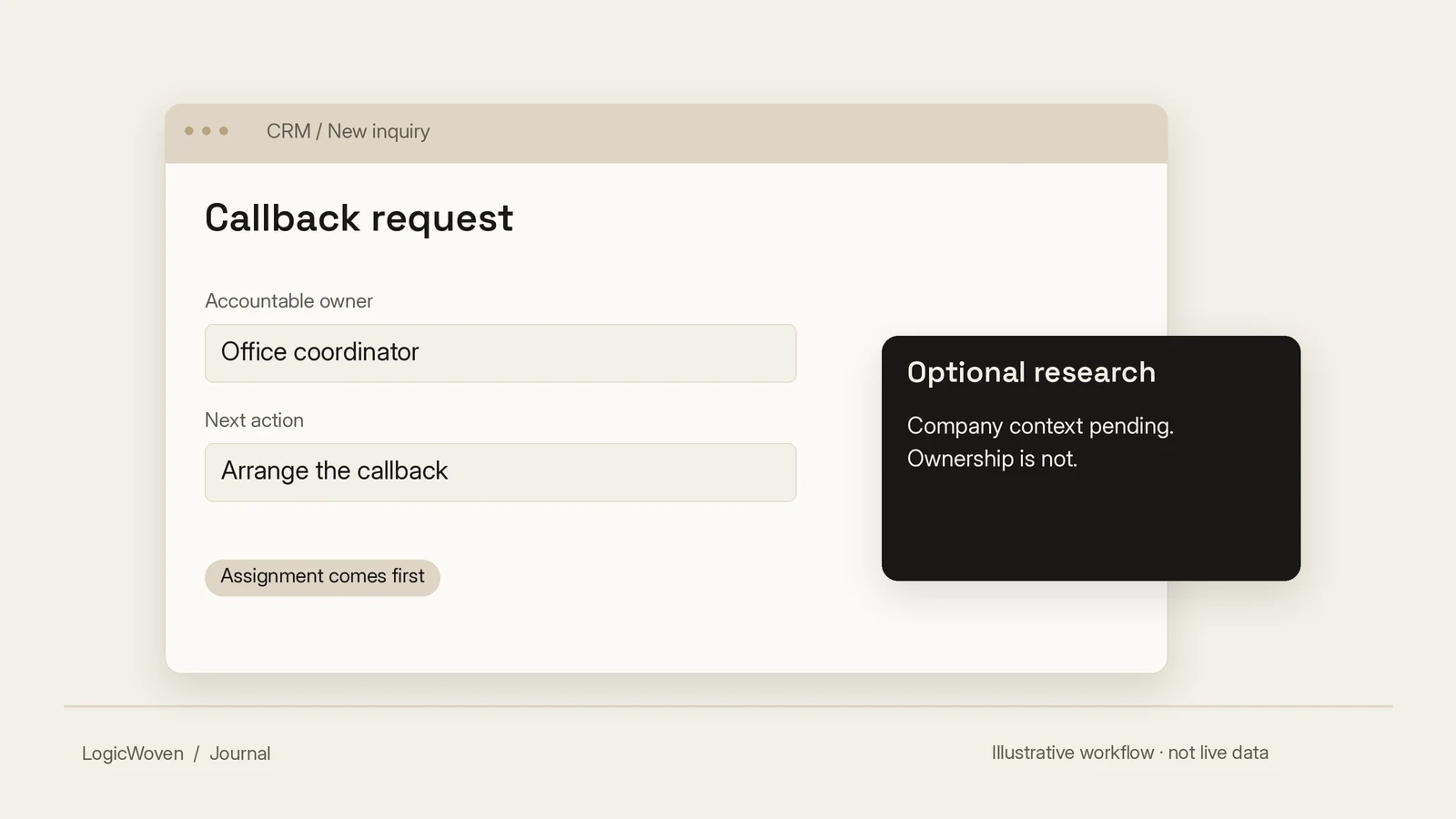
Assign a new inquiry to an accountable person or a staffed intake queue before optional enrichment begins. Extra company information can help a reviewer, but it should not determine whether anyone is responsible for the request. If enrichment fails, the inquiry should still have an owner and a visible next action.
This is an ownership design, not a lead-scoring strategy. A routing rule decides who must handle the work. A qualification or scoring rule decides how to evaluate the opportunity. Keeping those decisions separate prevents uncertain or incomplete inquiries from becoming nobody's responsibility.
For a small sales or office team, the practical question is not “how much can we learn about this lead?” It is “who will notice if this person never receives a useful response?”
Define what counts as ownership
A notification to several people is not the same as an assignment. An inbox can be a valid destination only if someone is responsible for checking it, accepting work, and covering absences.
Use a working definition: an owned inquiry has an accountable role, a currently assigned person or staffed queue, a next action, and a review time. The exact fields depend on your CRM, but the business meaning should not change between the website, integration, and office procedure.
Name the backup too. “The team will handle it” leaves the same ambiguity under a different label. For a very small business, the owner may be both primary and fallback, but that concentration should be visible before promising coverage.
The first assignment does not have to be final. An intake coordinator can own the request while clarifying which specialist should take over. What matters is that a transfer is explicit rather than a silent disappearance from one person's view.
Separate required facts from helpful facts
Identify the minimum information needed to choose an initial owner. It might be the selected service, the form used, or an existing customer reference. Keep optional company research, website summaries, and inferred business attributes out of the critical path unless a real policy requires them.
Webflow documents a form_submission webhook trigger and a form-name filter that can limit which submissions notify a destination.[3] That supplies a possible starting event; it does not supply your business's assignment rules or guarantee that a CRM owner will be set.
A proposed sequence is: capture the inquiry, validate the required fields, establish an initial owner, then perform permitted enrichment. Missing optional information becomes a note for the owner. Missing required information goes to an exception route with an owner of its own.
Do not let AI-inferred information overwrite the customer's stated need without review. Label inferred or externally sourced material so staff can distinguish it from what the person actually submitted.
Build an explicit routing table
Use a table that the office manager can inspect without reading code. State rule order, the owner, and what happens when the rule cannot be applied.
| Condition | Initial owner | Required action | Fallback |
|---|---|---|---|
| Existing customer reference matches an active account | Assigned account owner | Review the new request | Staffed intake if owner unavailable |
| New inquiry selects a supported service | Designated service intake person | Confirm need and next step | General intake backup |
| Multiple service categories selected | Intake coordinator | Clarify and coordinate transfer | Named manager |
| Service selection missing or unclear | Exception owner | Ask for necessary clarification | Intake backup |
| Inquiry arrives outside staffed hours | Assigned next-shift queue | Review when coverage resumes | Visible escalation policy |
| Optional enrichment fails | Existing inquiry owner | Continue using submitted information | No reassignment solely for failure |
These are illustrative rules, not a recommended universal org chart. Have the operations owner approve them before implementation; the Webflow trigger documentation does not validate staffing or assignment policy. Replace the conditions with your actual service structure and coverage. If two rules can match, decide which wins. If none match, ensure the default is visible, staffed, and tested.
Treat availability as operational data rather than a personal memory. Someone changing roles, taking leave, or leaving the business should trigger a routing update. Record who can approve that update and how it is tested before production use.
Hypothetical scenario: research delays a simple callback
A fictional facilities-service business receives an inquiry from a prospective customer. Its proposed automation attempts to research the company website before creating a callback task. The research step cannot confidently identify the company, so the run pauses with no owner assigned.
In a revised design, the submitted service category sends the inquiry to the office coordinator first. A callback task exists even if the research remains incomplete. Any retrieved business information is added later with its source and an uncertainty label.
If the coordinator discovers that the request belongs with another team, the coordinator transfers it explicitly and retains responsibility until the transfer is accepted under the agreed policy. The system does not wait for a perfect profile before making the work visible.
This is a hypothetical design comparison. It does not establish a particular response-time improvement or sales outcome.
Make transfers observable
A transfer needs more than changing a name in a field. Record who initiated it, the reason, the receiving owner, and whether the next action changed. Decide whether acceptance by the receiving person is required and who watches transfers that remain unaccepted.
Avoid routing loops. If service intake sends an inquiry to account management, and account management sends it back automatically because no active account exists, the customer has not moved closer to a response. Define a manual exception destination for contradictory rules.
Also decide how reopening works. A closed inquiry receiving a genuinely new request may need new work, while an internal note should not necessarily trigger reassignment. Inspect the actual CRM events and permissions before designing these transitions.
These are implementation requirements to validate, not claims about a specific CRM's default behavior.
Test ownership, not just notification delivery
For each routing branch, submit synthetic data and inspect the resulting CRM record. Check the assigned owner, next action, coverage expectation, and fallback. Do not end the test when a notification appears.
Include an unavailable primary owner, ambiguous service selection, a failed enrichment step, an after-hours inquiry, and conflicting account information. For each case, ask a staff member where they would find the work and what they would do next. If the explanation depends on the builder being present, the workflow is not ready for handover.
Track inquiries with no owner, time spent in unstaffed queues, transfers awaiting acceptance, and enrichment failures that interrupt assignment. Use the separate follow-up measurement guide for response quality; this routing review ends at accepted ownership and a visible next action.
Decide whether the extra research earns its place
Once ownership is dependable, evaluate enrichment as a separate addition. What decision does the extra information improve? Who checks its accuracy? Is the data appropriate to collect and use? Does it create more review work than it removes?
Include connected-tool costs, implementation, maintenance, human checking, and exception handling in the evaluation. Do not convert staff time released into cash savings unless an actual expense changes. Some workflows will be better with a clearer form and routing table alone.
LogicWoven can help organize CRM workflows, lead routing, and follow-up around explicit responsibilities. Discuss an inquiry-ownership review with your current routing rules and a few redacted examples that fell between teams. Start by making every valid inquiry somebody's work; decide what to enrich afterward.
Sources
[3] https://developers.webflow.com/data/docs/working-with-webhooks