
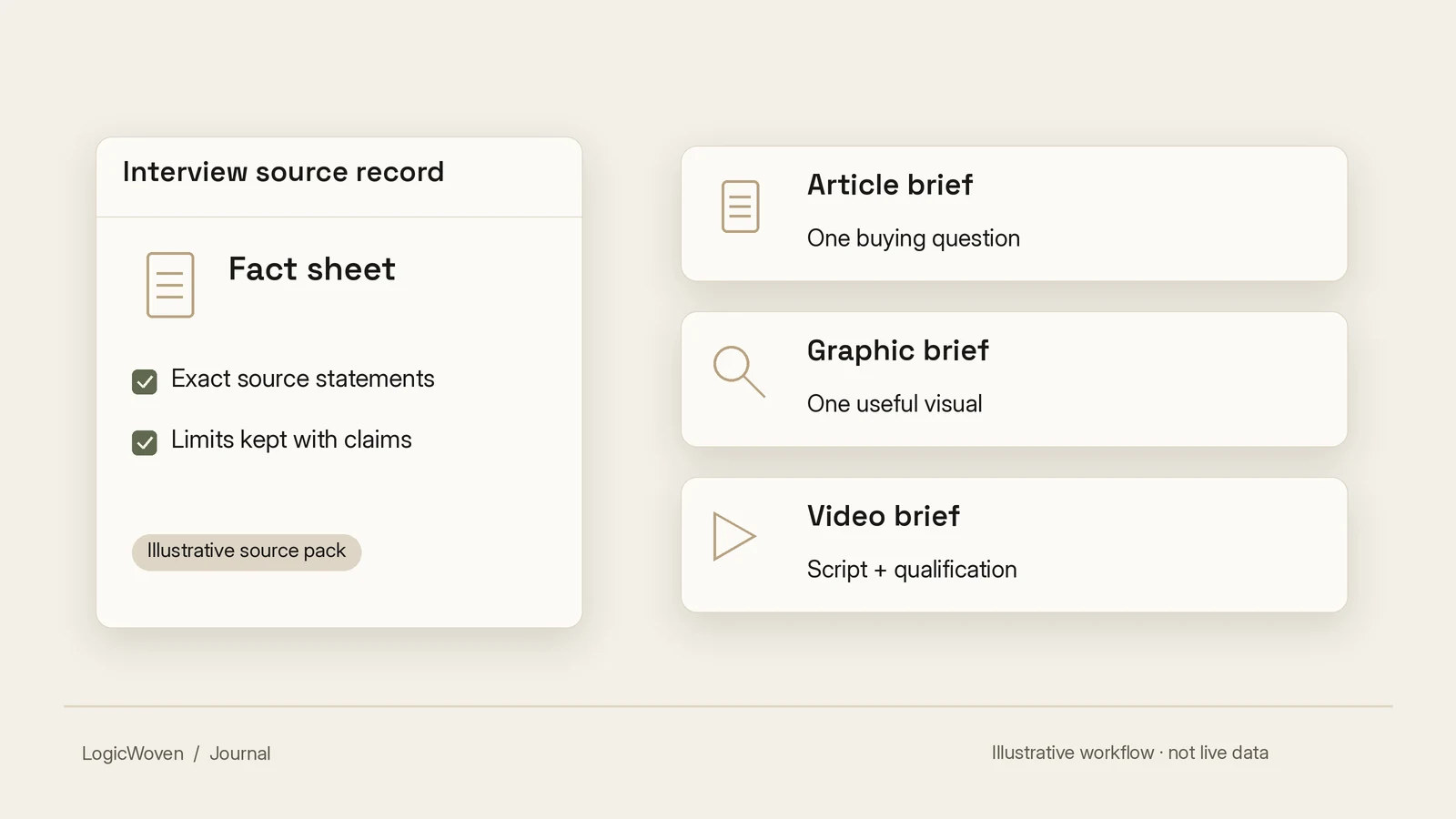
Turn a subject-matter interview into several marketing assets by creating an approved source record first, then adapting it for each format. Do not ask an AI tool to turn a recording directly into an article, graphics, and a video ready for publication. That shortcut leaves the team checking several versions of the same uncertain claims.
For a small business without a full-time content team, the objective is not maximum output from one conversation. It is a repeatable way to preserve expertise, remove unsupported statements, and produce the assets the business will actually use. A clear source-to-asset workflow makes that decision visible before design and editing begin.
Choose one buyer question for the interview
An interview framed as “tell us about the company” often produces material too broad for a useful article. Start with one decision a customer needs to make. Examples include what information is needed before an estimate, how to prepare for a service visit, or when a website integration needs an audit.
Send the expert a short brief containing the audience, the buying question, and the intended formats. Ask for explanations, exceptions, and examples that may be discussed publicly. Make it clear that a vivid anecdote is not automatically an approved case study.
During the interview, distinguish four kinds of material:
- Established facts with an available source.
- Business policies that an authorized owner can approve.
- Expert judgments that should be attributed and bounded.
- Illustrations that must remain labeled as hypothetical.
Confirm permission for recording, storage, transcription, and any planned use of the person's name or voice. This is a workflow recommendation, not a determination that a particular recording or marketing use is legally permitted.
Create the fact sheet before commissioning assets
The fact sheet is a working editorial record, not another public article. It lets the reviewer resolve uncertainty once instead of answering the same question separately for a designer, writer, and editor.
Use an entry for each material statement:
| Field | What belongs in it |
|---|---|
| Claim | The exact statement the asset may communicate |
| Origin | Interview passage, approved document, or external source |
| Evidence | Link or internal reference that a reviewer can inspect |
| Boundaries | Conditions, exceptions, dates, and exclusions |
| Approval | Named decision-maker and the approved version |
| Permitted use | Formats and contexts in which the statement may appear |
| Open question | What must be resolved before drafting continues |
Separate an expert's explanation from a business promise. “We usually review these documents first” may describe current practice without establishing a contractual commitment. The owner must decide which wording is appropriate for public copy.
Do not turn “customers tell us this is easier” into a testimonial, measured satisfaction claim, or percentage improvement. If supporting evidence is unavailable, rewrite the point as advice or omit it. The interview can identify useful research questions without proving the answers.
Map the source to formats with different jobs
Once the fact sheet is approved, choose assets by their role in the customer journey. An article can explain trade-offs. A graphic can summarize a process. A short video can demonstrate a specific preparation step. Reusing the source does not mean repeating the full article inside every format.
Create a source-to-asset map before production:
| Asset | Reader job | Material it may reuse | Approval needed |
|---|---|---|---|
| Article | Understand the decision and its limits | Supported explanation, exceptions, hypothetical example | Subject expert and editorial owner |
| Process graphic | Recall the sequence | Approved stage names and essential caveat | Content owner and design review |
| Short video brief | See one action explained clearly | Approved demonstration script | Expert, rights review, final cut review |
| Campaign caption | Decide whether to read or watch | Accurate promise about the linked asset | Marketing owner |
If the graphic needs so much qualification that its labels become unreadable, narrow the graphic. Do not simply remove the qualification. If a video requires footage or permissions that do not exist, retain it as a brief rather than representing it as a completed asset.
Commission from a source record, not a transcript dump
The following example is synthetic. It shows how an interview passage changes the production brief, not what a real expert said or approved.
| Source item | Editorial decision | Commissioning instruction |
|---|---|---|
| Interview note INT-A: “Have your existing page list ready” | Treat as proposed preparation advice; obtain subject review | Article explains how to list existing pages and flag missing owners |
| Interview note INT-B: “Every refresh is finished in a week” | Unsupported delivery promise; exclude pending commercial evidence | No turnaround claim in any commissioned asset |
| Source record PREP-A: approved preparation categories in this fictional exercise | Reuse only the bounded advice in this example | Graphic shows page list, available assets and open questions; label as preparation, not a delivery guarantee |
| Video idea: show an owner organizing assets | Footage and appearance permission are not supplied | Commission a storyboard; do not describe it as a completed video |
The coordinator gives each creator the relevant source references, intended reader job, required qualification, permitted format and unresolved dependencies. A designer should not have to decide whether the interview's casual timing claim is contractual. Resolve it in the source record before commissioning.
Approval of source wording permits preparation under the agreed brief; it is not approval of a final graphic, thumbnail or edit. Review meaning in the finished export separately, especially when a crop or caption removes context. That final-asset check belongs after commissioning rather than inside another copy of the fact-sheet tutorial.
Keep release authority separate
n8n documents human review for selected AI Agent tools, with approval executing the proposed input and denial canceling the action.[1] That supports an action gate, not verification of interview facts, recording rights or the complete editorial process.
If a publishing connector is used, verify that the exact release action is gated and bound to the approved version. Until then, retain manual release. A source record and a well-written prompt alone do not authorize publication.
Keep the workflow small enough to use
Assign an interview owner, a source reviewer, a production coordinator, and a release approver. One person can hold several roles, but the responsibilities should remain explicit. Give reviewers a clear decision: approve this version, request a specific correction, or reject the proposed use.
Track where material waits. Repeated review cycles may indicate an unclear brief, missing evidence, or too many assets commissioned at once. Count substantive corrections separately from stylistic changes so the team can see whether the source record is improving.
Measure approved assets actually used, not just files generated. Include transcription, research, design, editing, coordination, and review time when evaluating the workflow. Existing staff time released is not automatically money saved, and a larger content inventory is not evidence of more inquiries.
A practical starting point
Choose one upcoming interview and one article as the pilot. Add a supporting format only when its purpose and approval route are clear. Check confidentiality, ownership, source dates, and public claims before release; regulated or sensitive topics need appropriate qualified review.
LogicWoven can help coordinate content development, graphic design, video editing, and the project workflow around them. Discuss a source-to-asset content workflow with a buyer question, an available expert, and a named approver. That is a firmer starting point than asking for a month's content from an unreviewed transcript.
Sources
[1] https://docs.n8n.io/build/integrate-ai/ai-examples/human-in-the-loop-for-tools