
When a human reviewer denies an AI-proposed action, the action should stop, the reason should remain visible, and the workflow should move only to an explicitly permitted next step. Denial must not become an invitation for the agent to rephrase the request, try another tool, or ask a different person until someone approves.
In n8n's documented human-review flow, denial cancels the proposed tool action and informs the AI of the rejection.[1] That is the immediate tool behavior. Your team still needs to define what the larger business process should do afterward.
This article focuses on that denial path. Choosing which actions need approval and staffing the review queue are related decisions, but neither answers what “no” means for a particular request.
Separate a canceled action from a completed customer task
Suppose an AI assistant drafts a customer reply containing an unsupported delivery promise. A reviewer denies the send. The immediate safety objective is met if the message does not go out. The customer's original inquiry, however, may still need a response.
A good denial design preserves both facts: the send was rejected, and the underlying inquiry remains unresolved. Marking the entire inquiry complete would hide work. Restarting the send automatically would undermine the decision.
Define the next state at the business level. It might be “needs corrected draft,” “manual response required,” “waiting for clarification,” or “request declined.” These are proposed workflow states, not built-in n8n status guarantees. Choose states that tell the next person what they can do.
Give denials a reason without creating loopholes
Use a small set of reason categories that lead to different permitted next steps. The reviewer should not have to compose an essay, but “rejected” alone may be too vague for recovery.
| Denial reason | Permitted next step | What must not happen automatically |
|---|---|---|
| Unsupported claim | Revise from approved information | Repeat the claim in softer wording |
| Wrong recipient | Verify the intended recipient | Send to a guessed alternative |
| Missing authority | Ask the authorized owner for a decision | Route around the required approver |
| Sensitive information | Move to the defined secure/manual process | Copy the information into another channel |
| Outdated input | Refresh facts and create a new proposal | Reuse an old approval |
| Action not appropriate | Close or manually resolve under policy | Try a different tool for the same outcome |
A reviewer may need a free-text explanation, but store it where the right people can access it without exposing sensitive details more broadly. Distinguish internal reasons from customer-facing language. A customer generally needs an accurate next step, not a transcript of the team's internal security discussion.
Configure the agent, then test the enforcement
n8n's documentation says the agent's system prompt should explain the human-review setup, which tools require approval, what happens on denial, and how the agent should respond to rejection.[1] Use that configuration to make the intended behavior understandable.
For example, an internal instruction might say that a denied send cannot be retried until a new version is reviewed, and that missing information should produce a clarification task rather than an external message. This is a proposed policy, not a complete secure prompt or a claim of automatic enforcement.
Review the actual tool connections and permissions as well. If an agent has another ungated tool that can perform the same consequential action, a prompt alone is not a dependable boundary. Test alternate routes, subworkflows, and manual replay behavior within the authorized scope.
Do not infer that canceling one tool call reverses earlier steps. If another authorized action already changed a record, the team needs to inspect that state and decide whether a separate correction is necessary.
Make a revision a new decision
A changed proposal should have a new version, with the earlier denial preserved. Show the reviewer what changed and why the revised action is now being requested. Avoid presenting a nearly identical proposal without its history.
The approval must apply to the actual parameters that will execute. If the recipient, amount, attachment, record target, or public wording changes materially after review, require a new decision under the relevant policy. Do not treat approval of a general intention as permission for any implementation the agent later selects.
Set a resubmission rule. Some denials may allow a corrected draft; others should terminate automation for that request. If the same issue keeps returning, move it to a person rather than consuming reviewer attention in a loop. Any numerical retry limit should be selected for the workflow and tested, not copied as a universal best practice.
Hypothetical scenario: a rejected follow-up promise
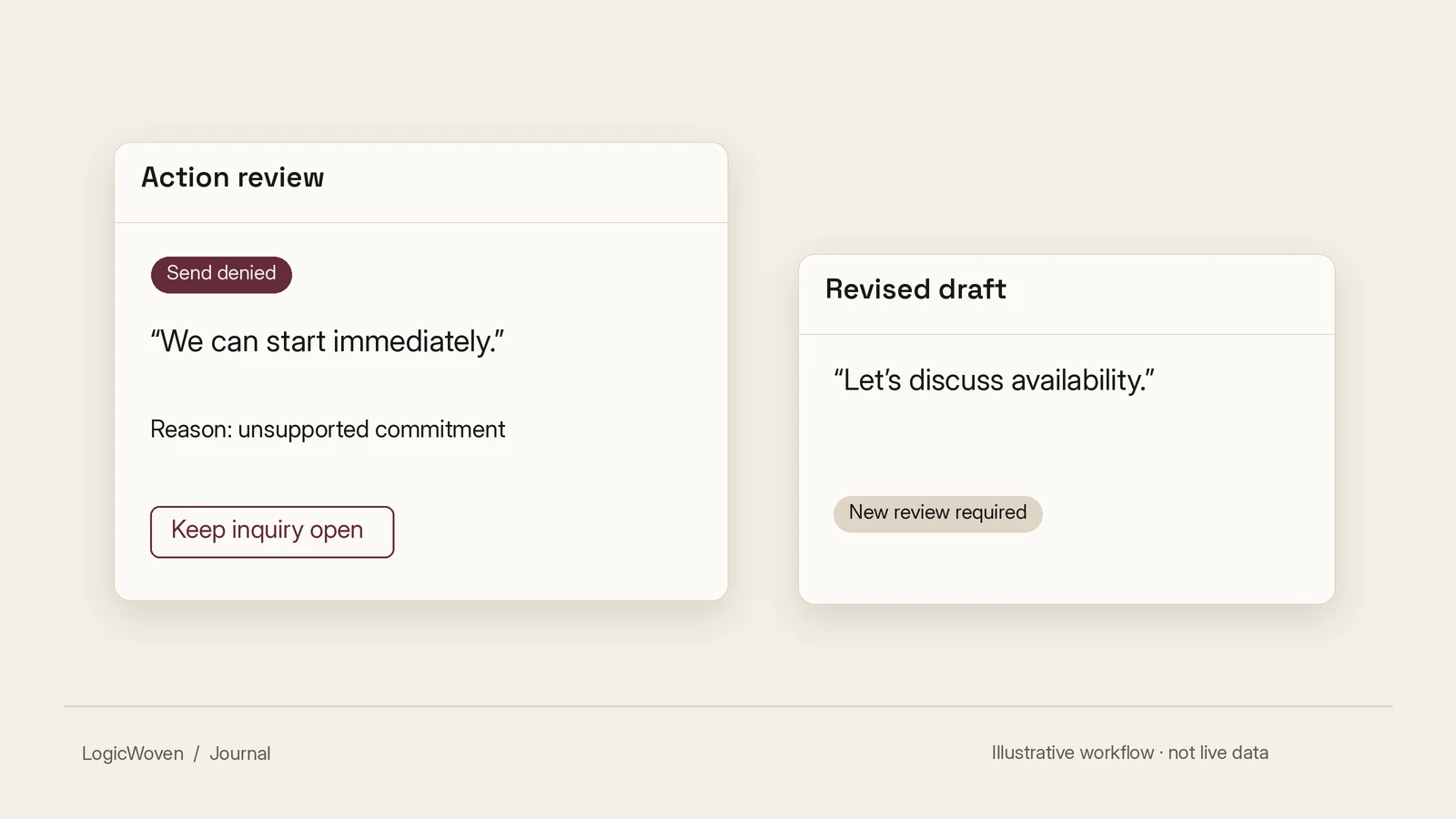
A fictional consulting team uses an AI assistant to prepare replies. The assistant proposes telling a prospect that a project can start immediately. The reviewer denies the send because no start date has been approved.
The proposed denial path records “unsupported commitment,” leaves the inquiry open, and creates a revised draft using approved wording about discussing availability. The reviewer sees the new draft together with the original reason. If no suitable wording can be produced, the inquiry moves to a named person for a manual reply.
The agent cannot send the original message through another connector or remove the approval step. The prospect is not told that a booking exists when it does not. This is an illustrative design, not a tested n8n configuration or a LogicWoven case study.
Denial-path test cases
Use synthetic recipients and records, with external sending disabled during testing unless separately authorized. Retain evidence of what did not execute as well as what happened next.
- Reviewer denies a send: no message is sent; the underlying task stays visible.
- Reviewer denies a record change: the targeted change does not occur; any earlier state is inspected separately.
- Agent proposes the same action again: the workflow follows the resubmission policy rather than silently retrying.
- Agent selects another tool: the same action boundary still applies.
- Corrected parameters arrive: the new proposal receives a new review decision.
- Reason is incomplete: a person clarifies the next step without executing the rejected action.
- Reviewer changes their mind: an explicit new authorization is required; historical denial is not edited away.
- Workflow is replayed: replay does not convert a previous denial into approval.
Passing these tests does not certify the system as safe or compliant. It gives the team evidence about a defined set of behaviors in a particular implementation.
Measure whether “no” leads somewhere useful
Track denial reasons, unresolved tasks after denial, repeated requests for the same rejected action, and the time reviewers spend correcting proposals. Separate legitimate caution from avoidable draft defects. A lower denial rate is not automatically better if reviewers have stopped inspecting the requests.
Budget for review, correction, and manual resolution alongside model and software costs. If denial recovery consumes more effort than the original task, narrow the automation or return that task to a person. The point is bounded assistance, not preserving an agent at any cost.
LogicWoven can help define AI-assisted workflows and the project requirements around their approval paths. Discuss a denial-path review with one consequential action and examples of what a reviewer might reject. Start by proving that “no” is respected and that the remaining work still has an owner.
Sources
[1] https://docs.n8n.io/build/integrate-ai/ai-examples/human-in-the-loop-for-tools