
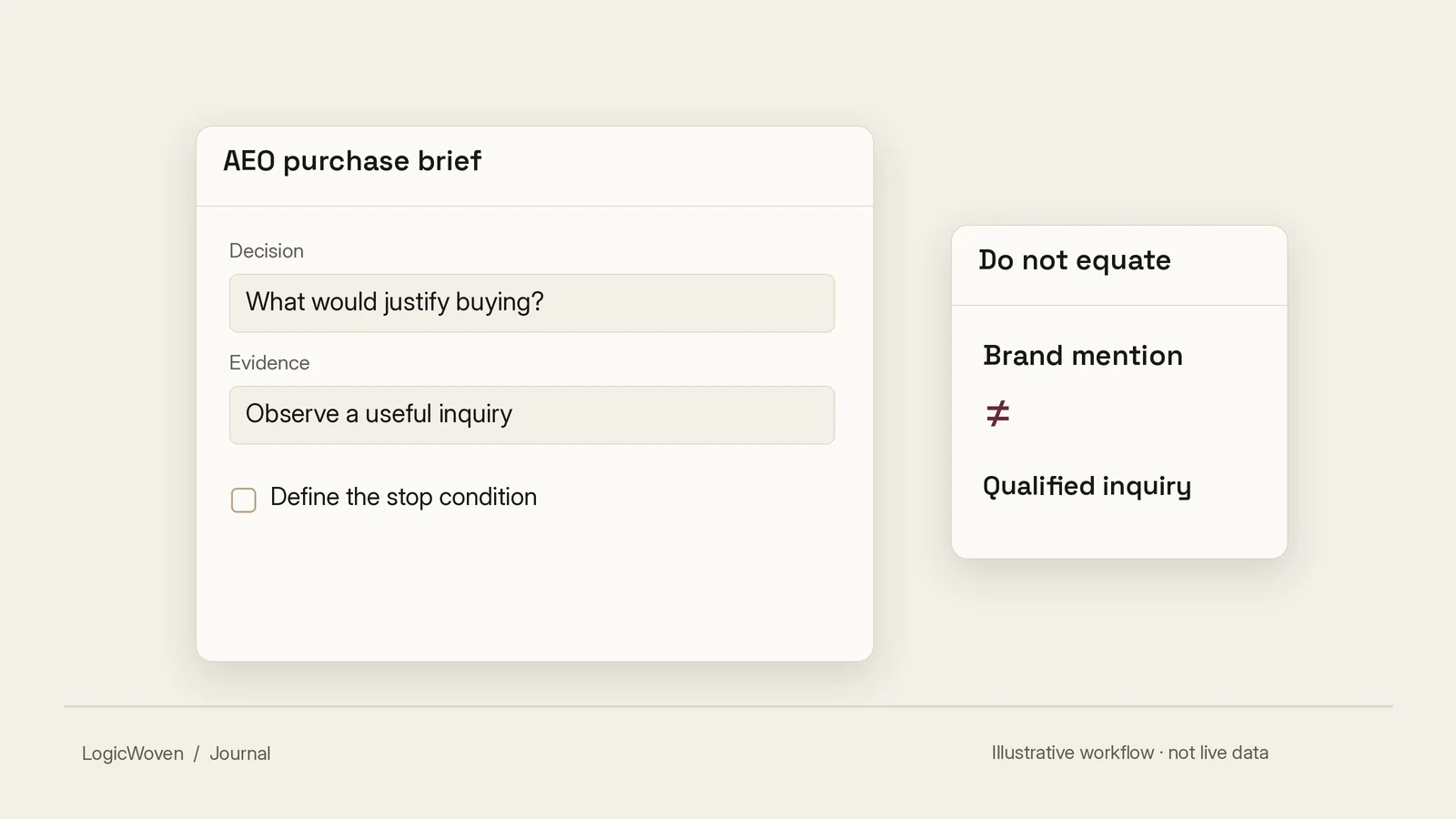
Buy AEO software only after deciding what evidence would justify the purchase. A brand mention, a linked citation, a website visit, and a qualified inquiry are different events. Start with the customer question you want to answer, the measurement you can actually observe, and the decision the tool would help you make.
AEO means answer engine optimization; GEO, or generative engine optimization, is another term used in discussions of AI discovery. For a small-business owner, the labels matter less than the proposal's substance: what will be measured, what will change, who will approve it, and what would make you stop paying?
A product announcement is not your business case
Webflow's April 13, 2026 announcement described an Enterprise AEO offering in private beta, with analytics in an upgraded Enterprise Analyze plan and dedicated agents in the Enterprise platform.[6] It described measurement, recommendations, and site changes with review-before-publish safeguards.[6]
That is a dated vendor announcement, not independent evidence that your business needs the product. It also does not establish current access, current pricing, or suitability for a small team. Confirm eligibility and commercial terms directly before treating an announced capability as an available purchasing option.
Use this as a general procurement rule: distinguish what a vendor says the product does from what you have verified in your account and what your business can gain from acting on the output. A polished visibility chart may still leave the operating decision unclear.
Define the evidence ladder
Use separate labels in the buying brief rather than combining every appearance into “AI traffic.” The distinctions below are a proposed measurement vocabulary, not an assertion that every tool can observe every stage.
| Evidence level | What you need to observe | What it does not establish |
|---|---|---|
| Mention | A recorded answer names the business | A link, a visit, or a recommendation |
| Citation | The answer includes an identifiable source link | That a person clicked or became a buyer |
| Visit | Website analytics records a visit with available source evidence | Every prior AI exposure in the journey |
| Qualified inquiry | An inquiry meets written business-fit criteria | That one content change caused it |
| Accepted opportunity | The team accepts a relevant next sales step | Revenue or profitability |
A tool may be useful at one level without measuring the next. The problem is not limited visibility; it is presenting a limited observation as something broader.
If the proposed tool samples prompts, ask how prompts are selected, how often they are repeated, which engines are included, and what context is retained. Require access to the observed answers or sufficient underlying evidence to review the finding. Treat a prompt panel as a sample, not a census of all customers' questions.
The LogicWoven AEO purchase brief
Complete this before requesting a demonstration. Leave unknown fields visible and give someone responsibility for resolving them.
- Buyer question: Which real service-selection question matters to our customers?
- Audience and geography: Who is the question for, and where can we serve them?
- Current answer: Which existing page answers it, and what is missing?
- Baseline evidence: What can we observe before making changes?
- Tool function: Does the product measure, recommend, edit, publish, or combine these?
- Decision rule: Which observed finding would lead us to take a specific action?
- Approval owner: Who checks factual, brand, and service claims before changes go live?
- Business measure: How will we record relevant inquiries without inventing attribution?
- Cost scope: What subscription, setup, content, engineering, and review work is needed?
- Stop rule: What result, evidence gap, or workload would make us pause or cancel?
Set the trial period and acceptance criteria before seeing the dashboard. Otherwise, it is too easy to redefine success around whichever metric improves. The criteria can be qualitative when data is sparse: for example, whether the tool exposes a verifiable content gap the team can fix. Do not pretend that a small trial can establish a reliable revenue effect.
Check whether ordinary website work is the real priority
Google's official guidance says foundational SEO remains relevant for its generative AI search features and emphasizes useful, non-commodity content and clear technical structure.[7] It also says there is no special schema required for generative AI search and no need for special AI text files such as llms.txt for Google Search.[7]
That does not make every visibility tool unnecessary. It means a proposal should not sell a special file or formatting ritual as a prerequisite for Google's AI results. Ask what useful work the tool adds beyond a clear service page, truthful sourcing, accessible content, and an understandable next step.
Google's guide specifies indexed, snippet-eligible pages and inclusion through the Search Console generative AI control as eligibility requirements.[7] Check actual site conditions with authorized access rather than assuming a new subscription will fix them. Eligibility is a prerequisite to evaluate, not a promise that a particular answer will cite the business.
Hypothetical trial: a service page that does not answer the question
Imagine a small service business whose potential buyers need to understand coverage, project fit, and what happens after an inquiry. This is a planning example, not a LogicWoven case study or measured search result.
A visibility tool reports limited appearances for selected questions. The owner inspects the underlying answers, then reviews the website. The service page does not clearly explain exclusions or the first consultation. The immediate action is to improve that explanation with owner-approved facts.
The team records the change, keeps the sampling method consistent, and watches available inquiry evidence. If answer appearances change, it notes that observation without claiming that the edit caused every later inquiry. Other marketing activity, audience differences, and ordinary variation remain possible explanations.
The tool has earned consideration if it helps the team find and prioritize useful work with evidence it can inspect. It has not earned a revenue claim merely because a graph moved.
Ask a better set of demonstration questions
Ask the supplier to trace one recommendation back to its evidence. What answer, page, or technical observation produced it? Can staff reject the recommendation? Who can publish changes? Can the business export its data and retain a change history?
Then ask what the product cannot see. Can it distinguish mentions from linked citations? Does it report sampled prompts or observed customer queries? Which metrics are estimates? What happens when a source is unavailable? An honest limitation is more useful than a universal “AI visibility score” with an unexplained formula.
Budget for people who will act on the findings. Subscription, implementation, content production, technical fixes, review, and maintenance belong in the decision. If the team cannot use the output, a larger dashboard is unlikely to resolve the constraint.
Make the buying decision explicit
Choose among buying, running a bounded trial, fixing foundational issues first, or deferring. Record why and what evidence would change the decision. No plan should promise rankings, AI citations, or sales that have not been observed.
LogicWoven can help assess the evidence, audit the digital journey, and turn findings into a focused action plan. Discuss an evidence-led digital audit. Bring the proposal you are evaluating and the customer question you want your website to answer better.
Sources
[6] https://webflow.com/updates/introducing-webflow-aeo-for-enterprise
[7] https://developers.google.com/search/docs/fundamentals/ai-optimization-guide